History of Yoga: Timeline, Definition, Philosophy & Key Facts
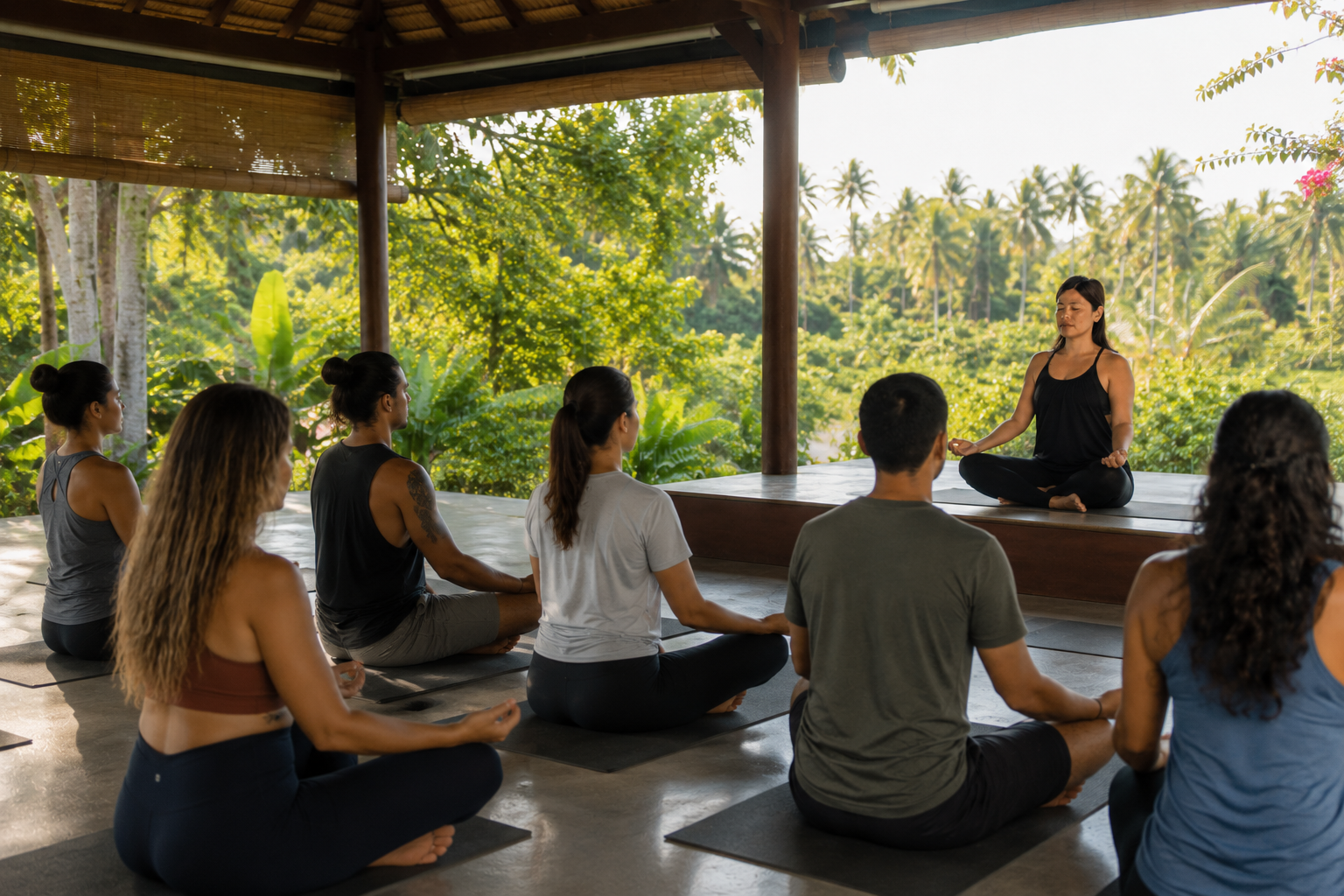
If you’ve ever taken a yoga class, it’s easy to think yoga began with sun salutations, stretchy poses, and a good Savasana.
But yoga is much older than that.
Long before yoga studios, leggings, and social media, yoga was a path of self-inquiry. It was a way of understanding the mind, relating to others with more compassion, and ultimately reducing suffering.
The physical practice is only one chapter in a story that has unfolded over thousands of years.
In this guide, we’ll explore where yoga came from, how it evolved, who shaped it, and why understanding its history can deepen the way we practice today.
Quick answer: The definition of yoga begins with Sanskrit yuj (“to yoke”). Patanjali defines it as stilling the mind’s fluctuations. Use this yoga history timeline and yoga history facts as a free history of yoga PDF—print this page from your browser—or start with yoga history on Wikipedia and go deeper from there.
What does yoga mean?
The word yoga comes from the Sanskrit root yuj, often translated as to yoke, to unite, or to join.
People often say yoga is the union of body, mind, and spirit. While that’s a beautiful way of describing it, different traditions understand yoga in different ways.
In the Yoga Sutras, Patanjali offers one of the most well-known definitions:
Yogaś citta-vṛtti-nirodhaḥ
Yoga is the stilling of the fluctuations of the mind.
That definition has shaped yoga history and philosophy for centuries.
Today, many people know yoga through asana, the physical postures. And that’s a wonderful place to begin. But historically, yoga has always been much bigger than the poses.
Traditionally, yoga includes:
- Yama — how we relate to others
- Niyama — how we relate to ourselves
- Asana — posture
- Pranayama — working with the breath
- Pratyahara — turning the senses inward
- Dharana — concentration
- Dhyana — meditation
- Samadhi — deep absorption or integration
This is one of the reasons I love teaching yoga. Students often come because they want to move their bodies, but somewhere along the way they discover something much deeper. That’s the spirit behind both Asana Foundations and our online 200-hour yoga teacher training—meet people where they are, and let the practice unfold from there.
Why is yoga still important today?
The importance of yoga isn’t abstract. Yoga has survived for thousands of years because it continues to meet people where they are.
Some people come to yoga because of back pain.
Some because of anxiety.
Some because life simply feels overwhelming.
And while many notice physical benefits first, what often keeps them practicing is the relationship they begin building with themselves.
Yoga teaches us to become more aware before reacting.
To breathe before speaking.
To notice rather than judge.
To cultivate qualities like ahimsa (non-harming), satya (truthfulness), and upekkhā (equanimity)—the name behind Upekkha Yoga School.
These teachings feel just as relevant today as they did centuries ago.
A brief history of yoga
Like most ancient traditions, yoga didn’t appear all at once.
It evolved gradually over thousands of years.
Rather than thinking of one person inventing yoga, it’s more accurate to think of generations of practitioners refining and expanding it.
| Period | Approximate Era | What Happened |
|---|---|---|
| Pre-Vedic & Indus Valley | c. 3000–1500 BCE | Archaeological discoveries suggest early contemplative or ritual practices, though scholars continue to debate their connection to yoga. |
| Vedic Period | c. 1500–500 BCE | The Vedas and early Upanishads introduce ideas about meditation, sacrifice, breath, and self-realization. |
| Classical Yoga | c. 200 BCE–500 CE | Patanjali systematizes yoga through the Yoga Sutras and the Eight Limbs. |
| Epic & Puranic Period | c. 400 BCE–1000 CE | The Bhagavad Gita presents different paths of yoga including karma, bhakti, and jñāna. |
| Medieval Hatha Yoga | 9th–17th century | Texts like the Hatha Yoga Pradipika introduce practices involving pranayama, mudra, bandha, and physical discipline. |
| Modern Yoga | Late 1800s–present | Teachers such as Krishnamacharya and his students bring posture-based yoga to the world. |
| Online Era | 2000s–present | Yoga becomes more accessible through online classes, teacher trainings, and global communities. |
One of my favorite things about studying the yoga history timeline is realizing that yoga has never stopped evolving. It has adapted across centuries while still pointing people toward the same questions: Who am I? What causes suffering? How can I live with more awareness?
Yoga history facts that surprise many students
Here are a few yoga history facts I wish I had known when I first started practicing.
- Yoga is older than most people realize and has developed over thousands of years.
- Yoga isn’t just exercise. Physical postures are only one part of the tradition.
- Many poses commonly practiced today are relatively recent compared to yoga’s long history.
- Classical yoga places tremendous importance on ethics, meditation, and self-study.
- Yoga developed alongside Hindu, Buddhist, and Jain traditions, which often influenced one another.
- Yoga continues to evolve. Every generation carries the responsibility of practicing and teaching it with care.
If you want to go deeper into practice philosophy, I love pairing history with lived study—like our reflection on sthira and sukha or what RYT 200 certification actually asks teachers to learn.
Yoga history and philosophy
For me, yoga history and philosophy are difficult to separate.
When we practice pranayama, we’re participating in a tradition that has been refined for centuries.
When we sit in meditation, we’re joining generations of practitioners who asked many of the same questions we ask today.
When we study the yamas and niyamas, we’re not memorizing rules. We’re exploring how to live well.
The Bhagavad Gita reminds us that there isn’t only one path.
There is Karma Yoga, the path of action.
Bhakti Yoga, the path of devotion.
Jnana Yoga, the path of wisdom.
The Yoga Sutras present another framework through the Eight Limbs.
None of these are competing systems. Together they show the richness of yoga as a living tradition.
If you’re considering teacher training, pair this overview with how to prepare for YTT or our free YTT Readiness Assessment.
Who is the father of yoga?
This depends on what we mean by “father of yoga.”
If we’re talking about Classical Yoga, Patanjali is often given that title because he organized the teachings into the Yoga Sutras, one of yoga’s most influential texts.
In Hindu tradition, Shiva, often called Adiyogi, is regarded as the first yogi. This is a sacred and symbolic understanding rather than a historical one.
If we’re talking about the posture-based yoga practiced in many studios today, T. Krishnamacharya is often called the father of modern yoga. Through students like B.K.S. Iyengar, K. Pattabhi Jois, and T.K.V. Desikachar, his teachings shaped much of contemporary yoga around the world.
Rather than asking who invented yoga, I think it’s more helpful to ask which tradition we’re studying.
Yoga has many roots.
Where should you learn yoga history?
Yoga history Wikipedia is often where people begin, and that’s perfectly fine for getting a general overview.
But if you’re serious about understanding yoga, it’s worth spending time with the primary texts.
Read the Yoga Sutras.
Read the Bhagavad Gita.
Read the Hatha Yoga Pradipika.
Study with teachers who respect both scholarship and lived practice.
The deeper I’ve gone into yoga, the more I’ve realized there’s always more to learn.
Looking for a history of yoga PDF? Bookmark this page or use your browser’s Print → Save as PDF option to keep this timeline and guide handy.
If you want structure rather than scattered reading, online 200-hour YTT weaves history, philosophy, anatomy, and teaching into one path—or begin with Asana Foundations if you’re newer to the mat.
Final thoughts
The history of yoga isn’t simply about remembering dates or names.
It’s about understanding the tradition we’ve inherited.
Every time we step onto the mat, we’re participating in something much older than ourselves.
Knowing where yoga came from reminds us to practice with humility.
To teach with integrity.
And to remember that yoga has never been about performing the most difficult pose.
It’s about becoming a little more aware, a little more compassionate, and a little more free.
That, to me, is what makes yoga timeless.
Related reading at Upekkha
- What Is Meditation? 5 Benefits & 4 Types
- What Is Yoga? Definition, Benefits & Risks
- Becoming a Yoga Teacher: Salary, Certification & Training
- Sthira and Sukha: Yoga Philosophy for Balance
- Everything Is Spiritual
- 8 Lessons From 8 Years of Teaching Yoga
- Yoga Alliance RYT 200 Certification Explained
- How to Prepare for 200hr YTT
References
- Bryant, E. F. (2009). The Yoga Sūtras of Patañjali: A New Edition, Translation, and Commentary. North Point Press.
- Feuerstein, G. (2008). The Yoga Tradition: Its History, Literature, Philosophy and Practice (3rd ed.). Hohm Press.
- Malinar, A. (2012). Bhagavadgītā. In Brill’s Encyclopedia of Hinduism. Brill.
- Singleton, M. (2010). Yoga Body: The Origins of Modern Posture Practice. Oxford University Press.
- Whicher, I. (1998). The Integrity of the Yoga Darṡana: A Reconsideration of Classical Yoga. State University of New York Press.
- Encyclopaedia Britannica. (n.d.). Yoga | Definition, History, & Facts.
- Wikipedia contributors. (n.d.). Yoga. In Wikipedia. Retrieved July 10, 2026.
- Swami Muktibodhananda (trans.). (1998). Hatha Yoga Pradipika (4th ed.). Yoga Publications Trust.
- International Association of Yoga Therapists. (n.d.). Research and education resources on yoga.
Study yoga history and philosophy with Upekkha
Beginner immersion or online 200-hour certification—rooted in steadiness, ease, and equanimity.