What Is Meditation? A Beginner’s Guide to How It Works, Its Benefits & Different Types
What exactly is meditation? This beginner’s guide answers how exactly do you meditate, what are the 5 benefits of meditation, and what are the 4 types of meditation—mindfulness, metta, trāṭaka, and walking meditation.
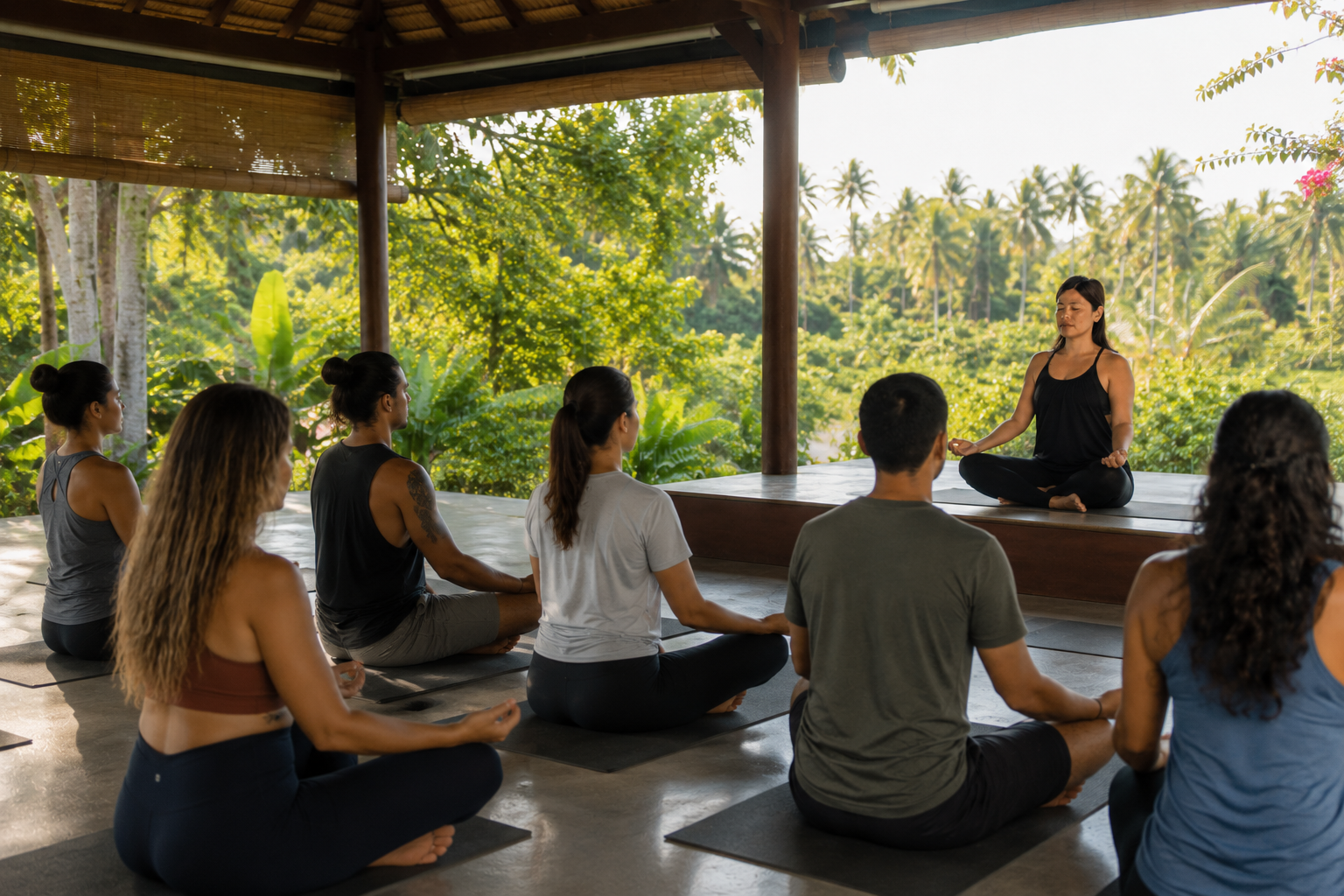
If someone had asked me what meditation was when I first started practicing yoga, I probably would have said, “It’s clearing your mind.”
Now I know that’s one of the biggest misconceptions about meditation.
Meditation isn’t about stopping your thoughts.
It’s about changing your relationship with them.
Our minds were designed to think. They wander, plan, remember, worry, imagine, and daydream. Meditation doesn’t ask the mind to become blank. Instead, it teaches us to notice what’s happening without immediately getting pulled into every thought.
Whether you’re completely new to meditation or looking to deepen your understanding, this guide will answer some of the most common questions people ask.
Quick answer: What exactly is meditation? Intentionally paying attention with awareness and kindness. How exactly do you meditate? Sit comfortably, follow your breath, and gently return when the mind wanders—start with five minutes. What are the 5 benefits of meditation? Less stress, better focus, emotional balance, improved sleep, and self-awareness. What are the 4 types of meditation? Mindfulness, loving-kindness, trāṭaka, and walking meditation. For a deeper list, see 20 benefits of meditation. Pair with yoga and meditation for a fuller practice.
What exactly is meditation?
Meditation is the practice of intentionally paying attention.
Different traditions use different techniques, but most forms of meditation share the same purpose: cultivating awareness.
Rather than trying to control every thought, meditation invites us to observe our experience with curiosity and kindness.
You might focus on:
- Your breath
- Bodily sensations
- Sounds around you
- A mantra or repeated word
- Loving-kindness toward yourself and others
- The present moment
Jon Kabat-Zinn, who helped introduce mindfulness into modern medicine, defines mindfulness as:
“Paying attention in a particular way: on purpose, in the present moment, and nonjudgmentally.”
While mindfulness and meditation aren’t exactly the same thing, mindfulness is often cultivated through meditation practice.
In the Buddhist tradition, meditation is a way of understanding the nature of the mind and reducing suffering. In yoga philosophy, meditation (dhyāna) is one of the Eight Limbs described by Patanjali, leading toward deeper states of absorption and inner stillness.
How exactly do you meditate?
One of the beautiful things about meditation is that it’s simple.
Not necessarily easy.
But simple.
Here’s a beginner-friendly practice you can try today.
- Find a comfortable position. You can sit on a chair, a meditation cushion, or the floor. You don’t need to force yourself into a cross-legged position if it’s uncomfortable.
- Allow your spine to feel long without becoming rigid.
- Close your eyes if that feels comfortable, or soften your gaze toward the floor.
- Bring your attention to your natural breath. Notice the inhale. Notice the exhale. You don’t need to change your breathing—simply observe it.
- When your mind wanders (it always does), gently return your attention to the breath.
That’s the practice.
Every return is a repetition.
Just like lifting a weight strengthens a muscle, returning your attention strengthens your awareness.
Start with five minutes a day.
Consistency matters much more than duration.
If sitting still feels difficult, try a few minutes of gentle asana first, then sit—movement often prepares the body for stillness.
What are the 5 benefits of meditation?
Meditation has been studied extensively over the past few decades. While everyone’s experience is unique, research suggests several potential benefits when practiced consistently.
1. Reduces stress
Meditation can help calm the body’s stress response and improve our ability to respond to difficult situations rather than react automatically.
Many people notice they feel less overwhelmed after developing a regular meditation practice.
2. Improves focus and attention
Meditation trains the mind to notice distractions and gently return to the present moment.
Over time, this can improve concentration at work, in school, and in daily life.
3. Supports emotional wellbeing
Meditation doesn’t eliminate difficult emotions.
Instead, it helps us develop a healthier relationship with them.
Rather than becoming overwhelmed by every emotion, we learn to observe our experience with greater balance.
4. Improves sleep
Many people find that meditation helps quiet mental chatter before bedtime.
Although it isn’t a cure for insomnia, relaxation and mindfulness practices may contribute to better sleep quality.
5. Increases self-awareness
Perhaps the greatest benefit of meditation isn’t becoming calmer.
It’s becoming more aware.
As awareness grows, we begin noticing habits, reactions, thought patterns, and beliefs that previously operated on autopilot.
That awareness creates the possibility for change.
What are the 4 types of meditation?
There are hundreds of meditation techniques around the world, but these four are among the most widely practiced.
1. Mindfulness meditation
Mindfulness meditation involves paying attention to the present moment without judgment.
The breath often serves as an anchor, although sounds, bodily sensations, and emotions may also become objects of awareness.
This is one of the most researched forms of meditation today.
2. Loving-kindness meditation (metta)
In loving-kindness meditation, we intentionally cultivate goodwill toward ourselves and others.
Practitioners silently repeat phrases such as:
- “May I be happy.”
- “May I be healthy.”
- “May I be safe.”
Gradually, these wishes are extended to loved ones, strangers, difficult people, and eventually all living beings.
3. Trāṭaka meditation (candle gazing)
Trāṭaka is a traditional yogic meditation practice described in the Hatha Yoga Pradipika. The word trāṭaka means “to gaze steadily.”
In this practice, you sit comfortably and gently focus your gaze on the flame of a candle without blinking as much as possible. When your eyes begin to water, you close them and observe the afterimage of the flame in your mind’s eye.
Trāṭaka is traditionally practiced to develop concentration (dhāraṇā), improve mental clarity, and prepare the mind for deeper meditation. It is also considered one of the Shatkarmas, the yogic cleansing practices, because it is believed to purify the eyes and steady the mind.
If you have eye conditions or experience discomfort, practice gently and stop if you feel any pain.
4. Walking meditation
Meditation doesn’t always happen sitting still.
Walking meditation involves bringing mindful awareness to each step, each breath, and the sensations of movement.
Many people find this practice especially helpful if sitting meditation feels challenging.
Common myths about meditation
One myth is that successful meditators never think.
The truth is that everyone thinks.
Meditation isn’t about eliminating thoughts.
It’s about noticing them.
Another myth is that you need to meditate for an hour every day.
Five to ten minutes of consistent practice is often more beneficial than an hour practiced once a month.
Finally, many people believe meditation is only for spiritual people.
Meditation can certainly be part of a spiritual path, but it can also be practiced simply as a way of developing attention, compassion, and emotional balance.
Tips for beginning a meditation practice
If you’re just starting, keep it simple.
- Choose the same time each day.
- Begin with five minutes.
- Use your breath as your anchor.
- When your mind wanders, gently return.
Some days your meditation will feel peaceful.
Other days your mind will seem unusually busy.
Neither is a good or bad meditation.
Showing up is the practice.
Final thoughts
One of my teachers once said that meditation isn’t about becoming a different person.
It’s about becoming more familiar with the person you already are.
I come back to that often.
Meditation hasn’t made my life free from stress or uncertainty.
It hasn’t stopped difficult emotions from arising.
What it has given me is a little more space.
A pause before reacting.
A deeper appreciation for ordinary moments.
And a reminder that awareness itself can be incredibly healing.
Whether you sit for five minutes or fifty, the invitation is the same.
Simply arrive.
Notice what’s here.
And begin again.
Related reading at Upekkha
References
- American Psychological Association. (2019). Meditation and Mindfulness: Effectiveness and Safety.
- Goyal, M., Singh, S., Sibinga, E. M. S., et al. (2014). Meditation Programs for Psychological Stress and Well-being: A Systematic Review and Meta-analysis. JAMA Internal Medicine, 174(3), 357–368. PubMed
- Kabat-Zinn, J. (1994). Wherever You Go, There You Are: Mindfulness Meditation in Everyday Life. Hyperion.
- Patañjali. Yoga Sutras. (Translated by Edwin F. Bryant, 2009). North Point Press.
- Shapiro, S. L., & Carlson, L. E. (2017). The Art and Science of Mindfulness. American Psychological Association.
- Tang, Y. Y., Hölzel, B. K., & Posner, M. I. (2015). The Neuroscience of Mindfulness Meditation. Nature Reviews Neuroscience, 16(4), 213–225. PubMed
- World Health Organization. (2022). Mental Health: Strengthening Our Response.
Want to weave meditation into a fuller practice?
Explore Asana Foundations for beginners or online 200-hour YTT for philosophy, breathwork, and meditation.